
Blog
Built in, not bolted on: where AI needs to fit in hospitals
The next phase of hospital AI will be determined less by what a model can do and more by what happens when it meets the reality of a working hospital.

This article is based on a presentation given at HINZ September 2026
There is no shortage of AI tools being presented to hospitals. Many can demonstrate impressive capabilities, from drafting clinical notes and identifying patterns to predicting risk and automating administrative work.
The harder question is what happens when that capability meets the reality of hospital operations.
Clinicians may already move between several systems during a shift. Information is copied between applications, and data that exists somewhere in the hospital may still need to be found, checked or entered again. Adding AI to that environment only improves the workflow if it removes some of that friction rather than creating another place for clinicians to go.
What happens to AI output in a hospital workflow?
Take clinical documentation. An ambient AI scribe can listen to a consultation and produce a draft note, removing a substantial part of the documentation task. But if the clinician then has to open another application, review the output and manually transfer it into the patient record, the technology has addressed one task without addressing the wider workflow.
A more useful test is what happens to the AI output next. Where does it go? Who needs to review or act on it? Does it become part of the patient record, or does someone have to enter it somewhere else?
Looking at the whole workflow also changes how we assess productivity. Time saved at one point matters much less if it creates additional work further along the patient's journey through the hospital.
Integration should remove work, not relocate it
Hospitals have spent years connecting clinical, administrative and operational systems, but systems being able to exchange information does not necessarily make that information useful at the point it is needed.
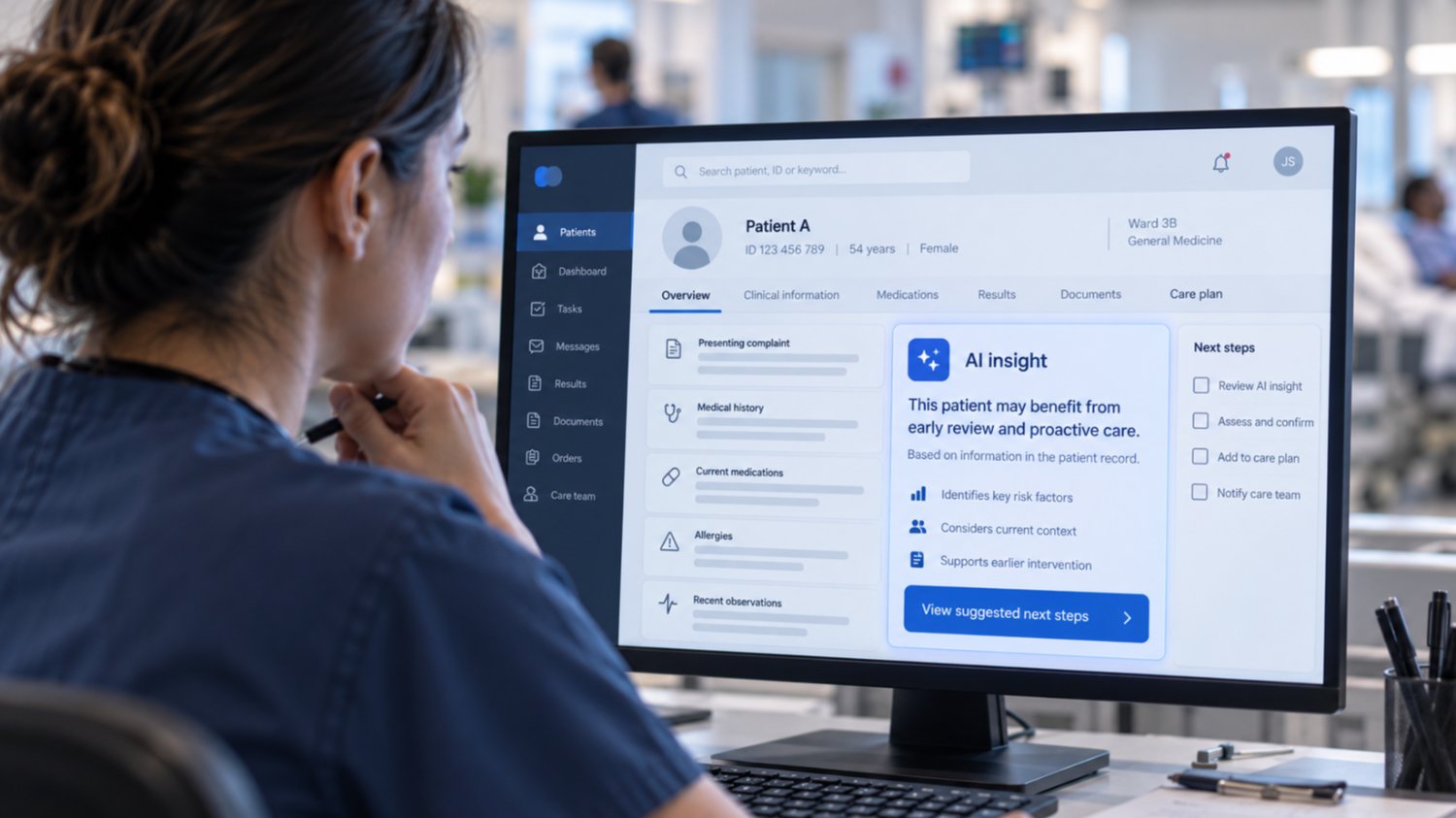
Pre-admission screening is a good example. AI can assess available patient information and identify people who may require additional attention before admission, but producing a risk score is only part of the job. The information also needs to reach the appropriate clinician early enough for them to do something with it.
That requires us to think beyond the AI model and consider how data, hospital systems and workflows operate together. It also means looking beyond a single task or department. A change that appears efficient in one part of the hospital may simply move work elsewhere.
What security and governance does hospital AI need?
As AI moves further into hospital workflows, security and governance become part of how the capability needs to be designed.
Hospitals need to understand what patient information an AI capability can access and on whose authority. Permissions need to reflect a person's role and context, activity needs to be auditable, and there needs to be clarity about where information is processed and stored and what becomes part of the patient record.
These requirements become harder to manage when AI operates as another separate application. Each additional system can introduce its own questions around identity, access and data movement, which have to be resolved before the technology can become part of routine hospital operations.
AI still has to work for the people using it
Embedding AI into hospital workflows does not mean handing those workflows over to AI. In many cases, its role is to bring relevant information forward, identify something that warrants attention or prepare work for a clinician to review.
The people doing the work need to be involved in deciding how that happens. Process diagrams rarely capture every workaround, duplication or handover that has developed across a hospital, so understanding the workflow before implementation matters. Feedback after go-live is equally useful because it shows whether the technology is removing friction in practice.
This is familiar territory for anyone who has implemented hospital technology. AI does not change the fundamentals of good implementation, even if the capabilities themselves are developing quickly.
Built in, not bolted on
Our experience implementing hospital information systems has shaped how we approach AI within Amalga.
Rather than starting with a model and finding somewhere to put it, we start with the hospital workflow and the information already available within it. The question is where AI can usefully contribute without requiring clinicians to leave that workflow to get the benefit.
For clinical documentation, that means considering how AI-assisted documentation can sit within the clinical module and become part of the patient record rather than operating as a separate destination. In pre-admission screening, it means looking at how risk can be identified from available information and surfaced to the appropriate clinician while there is still an opportunity to act.
Neither example is about adding AI for its own sake. They are examples of looking at an existing hospital workflow and identifying where AI can remove work or make useful information available earlier.
As the number of AI tools available to hospitals grows, that distinction will matter. A capable model can still be a poor addition to a hospital if implementing it introduces another application, another handover or another source of fragmentation.
The test is what happens to the hospital workflow once the AI is there.